

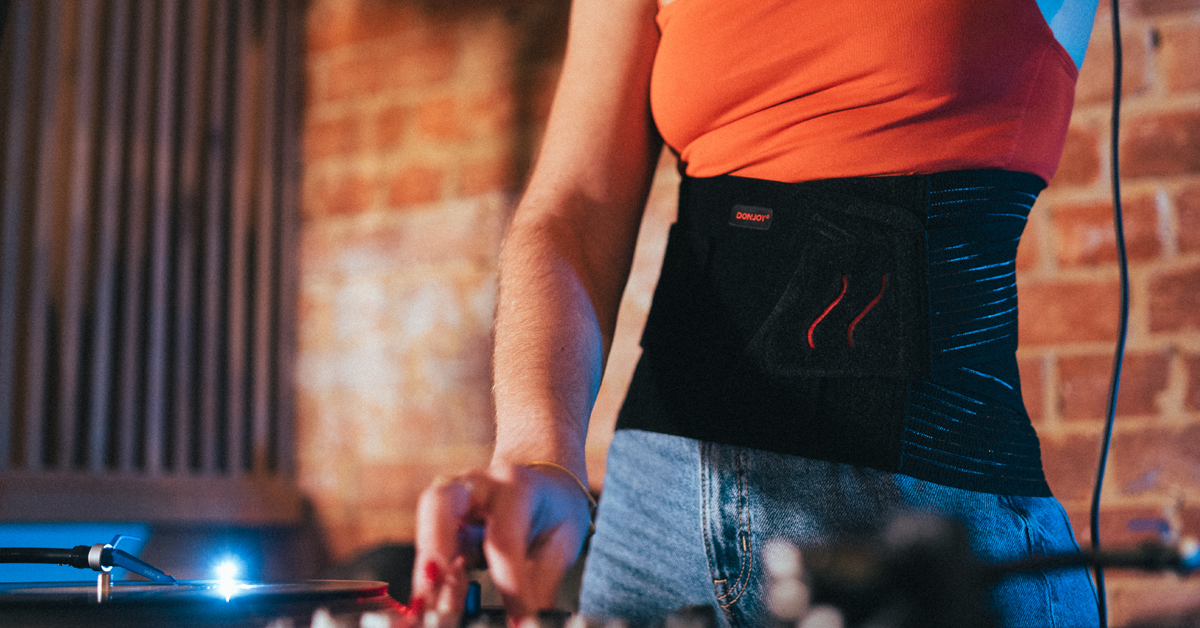
Chronic low back pain (CLBP) remains one of the most prevalent musculoskeletal conditions seen in clinical practice, affecting functional independence and quality of life across all demographics. Conservative management strategies — including patient education, exercise, and, where appropriate, manual therapy — are commonly used as first-line approaches for low back pain. Lumbar bracing remains a more selective intervention, with emerging evidence suggesting potential benefits in specific patient groups when prescribed as part of a broader care plan.
What Does the Evidence Say?
A 2023 systematic review by Oleiwi et al. brought together the highest-quality research on lumbar bracing for low back pain. After screening more than 14,600 published studies, the authors identified 13 randomized controlled trials — involving 1,838 patients in total — that met their inclusion criteria. All 13 were rated as the highest level of clinical evidence. When the results were pooled, lumbar bracing was shown to significantly reduce both pain and disability compared with control groups. The findings for disability were particularly consistent across the included trials. Among the different brace types studied, semi-rigid designs were associated with greater functional improvement than softer, more elastic supports — suggesting that a firmer level of support may offer more meaningful benefit during everyday activities.1
However, the authors also conceded that more rigorous randomized controlled trials are still needed to identify the type (rigid, flexible) of brace most useful, the mechanism of action, and the duration (short term, long term) of wearing the brace. Due to a smaller number of studies in their meta-analysis sections, their conclusion was limited and not generalizable, and more rigorous research is needed for a solid conclusion.
Addressing the ‘Muscle Weakness’ Concern
A persistent clinical concern is that prolonged lumbar brace use may lead to trunk muscle deconditioning. Two systematic reviews have directly examined this question. Azadinia et al. concluded that the available evidence does not support the assertion that lumbar bracing causes muscle weakness or atrophy during short-to-medium-term use.2 A systematic review with meta-analysis by Takasaki and Miki further demonstrated that lumbar-brace wear does not result in significant reductions in trunk muscle activity during functional tasks.3
These findings are reinforced by ultrasound imaging data showing no measurable atrophy of abdominal and lumbar muscles over four weeks of lumbar brace use.5
How Do Lumbar Braces Work?
Research using perturbation testing has quantified the biomechanical effects of lumbar braces, demonstrating increases in passive trunk stiffness alongside modulation of reflexive muscle responses — suggesting that braces support the spine through both mechanical and neuromuscular pathways.6 Beyond physical mechanisms, RCT data indicate that lumbar brace use is associated with reductions in pain-related anxiety and improvements in self-efficacy — psychosocial factors increasingly recognized as central to CLBP management.7
Outcomes in Daily Practice
One frequently cited randomized study in subacute low back pain comes from a multicenter randomized controlled trial (n=197) studying the use of a semi-rigid lumbar brace over three months, which demonstrated clinically meaningful improvements in both pain and disability outcomes. Another recorded benefit was the significant reduction in the consumption of pain medication in the braced group.8
A retrospective analysis of 199 patients using a rigid lumbar brace reported improvements in pain and disability scores that exceeded minimum clinically important differences at 3, 6, and 12 months.9 Although the latter study lacked a control group and therefore cannot establish causation, the subgroup analyses by diagnosis, age, and BMI provide a useful clinical picture of expected response patterns.
Matching the Orthosis to the Patient: DonJoy® Lumbar Bracing
Enovis™ offers two complementary lumbar support platforms under the DonJoy® brand, designed to match orthosis selection to individual patient needs across a spectrum of activity levels and clinical indications.
The DonJoy® Strap Range provides elastic and semi-rigid lumbar supports mapped across an activity–support matrix from light to strong. Skinstrap™, for instance, is a discreet, lightweight option with elastic webbing construction, four anatomically shaped dorsal stays, and dual hand loops for patient-controlled compression. Available in two heights (21 cm and 26 cm), it suits patients requiring support during daily activities without restricting mobility. The range extends through the Actistrap™ 2.0, and Porostrap models to the Immostrap 2.0 for maximum stabilization, with breathable materials and optional accessories including hot/cold therapy packs and massaging pads.
The DonJoy® LumboForce® range is a modular system of six products (LumboForce Sacro through LumboForce 5) incorporating patented adjustable technology. The range is indication-matched: LumboForce Sacro addresses symphysis and sacroiliac joint conditions; LumboForce 1–2 suit lumbalgia and degenerative conditions such as osteochondrosis; LumboForce 3 provides de-lordosis pain relief for disc herniation (stages 1–2) and facet syndrome; and LumboForce 4–5 offer rigid stabilization for more severe indications including advanced disc herniation, vertebral fractures, stenosis, and post-decompression support.
Clinical Considerations
Emerging evidence suggests lumbar bracing may offer selected patients short-to-medium-term support as part of a broader conservative management plan, although recommendations vary between guidelines and bracing should be prescribed according to clinical need. The available systematic review and RCT data indicate that short-to-medium-term brace use does not cause trunk muscle deconditioning,2,3 may improve postural stability and self-efficacy,5,7 and can complement exercise-based programmes.9 Matching the brace to the patient’s clinical indication, activity level, and functional goals remains essential for optimal outcomes.
For more information about the Enovis spine support portfolio, visit enovis-medtech.eu, or contact your local representative.
References
- Oleiwi M, et al. Efficacy of orthotic support in mitigating low back pain and disability in low back pain sufferers. J Back Musculoskelet Rehabil. 2023;36(5):1111-1125.
- Azadinia F, et al. Can lumbosacral orthoses cause trunk muscle weakness? A systematic review of literature. The Spine Journal. 2016;17(4):589–602.
- Takasaki H, Miki T. The impact of continuous use of lumbosacral orthoses on trunk motor performance: a systematic review with meta-analysis. Spine J. 2017;17(6):889-900.
- Cholewicki J, et al. The effects of a three-week use of lumbosacral orthoses on trunk muscle activity and on the muscular response to trunk perturbations. BMC Musculoskeletal Disorders. 2010;11:154.
- Azadinia F, et al. The Effect of Lumbosacral Orthosis on the Thickness of Deep Trunk Muscles Using Ultrasound Imaging: A Randomized Controlled Trial in Patients With Chronic Low Back Pain. Am J Phys Med Rehabil. 2019 Jul;98(7):536-544.
- Ludvig D, et al. The effect of extensible and non-extensible lumbar belts on trunk muscle activity and lumbar stiffness in subjects with and without low-back pain. Clin Biomech. 2019 Jul;67:45-51.
- Im S, et al. Analysis of the Effect of Wearing Extensible and Non-Extensible Lumbar Belts on Biomechanical Factors of the Sit-to-Stand Movement and Pain-Related Psychological Factors Affecting Office Workers with Low Back Pain. Healthcare (Basel). 2021 Nov 22;9(11):1601.
- Calmels P, et al. Effectiveness of a lumbar belt in subacute low back pain: an open, multicentric, and randomized clinical study. Spine. 2009;34(3):215–220.
- Vick T, et al. Efficacy of Back Bracing in Treating Chronic Low Back Pain. Brain Sci. 2024 Oct 30;14(11):1100.