

Back pain is one of the most common reasons people seek medical attention, and for many — particularly older women — the underlying cause is more serious than a simple muscle strain. Vertebral compression fractures and postural dysfunction driven by osteoporosis are increasingly prevalent conditions that can profoundly affect quality of life. The good news is that conservative management, including semi-rigid back bracing, offers a meaningful pathway to pain relief and functional recovery.
Understanding the Problem: Osteoporosis and Vertebral Fractures
Osteoporosis is a progressive condition that weakens bones, making them fragile and more likely to break. Bone loss is a natural part of ageing — by the age of 70, skeletal density has diminished by around a third — but for some people this process accelerates significantly. Women are particularly at risk, as bone loss speeds up markedly in the years following the menopause when oestrogen production falls.
Among the most serious consequences are Osteoporotic Vertebral Compression Fractures (OVCFs). These are the most common type of fracture associated with osteoporosis, with 1.5 million reported annual cases.1 OVCFs occur when the combined axial and bending loads on the spine exceed the strength of the vertebral body.
OVCFs are a major source of disability, as they can cause persistent back pain and kyphotic deformities (the characteristic forward curvature of the upper spine) that have a significant impact on the patients’ functional status and mortality rate.2,3
Conservative Treatment of Vertebral Fractures: Why Back Bracing Matters
The aim of OCVF treatment is to:
- Minimize pain
- Restore mobility
- Prevent additional fractures
With surgical intervention reserved for those with persistent pain and accompanying neurological issues, most patients can be treated conservatively with a combination of pain management, physiotherapy, and back bracing.4
Bracing works through several hypothesized mechanisms. It limits spinal motion to control pain, stabilizes injured structures, provides pressure to promote postural correction, reduces fatigue, and supports function and participation in daily activities.5,6 Not all braces are equal, however. Rigid braces have traditionally been used, but their limitations — including poor patient compliance, atrophy of trunk muscles, and restricted respiration — have driven the development of alternative options.7
The Case for Semi-Rigid Back Bracing
The clinical evidence points clearly in one direction: semi-rigid, dynamic bracing consistently outperforms both rigid and soft bracing across key outcomes.
A 2011 study by Jacobs et al. found that patients with OVCFs wearing a semi-rigid thoracolumbar orthosis showed significant improvements in gait at six weeks — walking 14% faster, taking larger strides, and reporting 68% less pain compared to baseline. Crucially, these gains were maintained at six months.8
A randomized trial by Pfeifer et al. (also 2011) demonstrated that after six months, women with postmenopausal osteoporosis wearing a semi-rigid orthosis showed significant increases in back extensor strength, body height, and lung capacity, alongside meaningful reductions in kyphosis angle, body sway, and pain — all compared to a control group not wearing a brace.9
When semi-rigid bracing was compared directly with soft bracing in a prospective study by Dionyssiotis et al. (2015), the semi-rigid group achieved a 37% reduction in back pain scores after six months, alongside significant improvements in abdominal and extensor muscle strength. Compliance was also strikingly higher — 90% for the semi-rigid orthosis versus just 50% for the elastic alternative.10
Semi-rigid bracing also compares favorably against rigid bracing. A 2017 comparative study by Meccariello et al. found significantly better outcomes at three and six months for pain, disability, and respiration in the semi-rigid group, with far fewer complications (8 patients versus 28 in the rigid brace group).7
Even when set against an active exercise program, a randomized controlled trial by Kaijser et al. (2019) found that a dynamic orthosis increased back extensor strength by 26.9% at six months — comparable to the 22.1% achieved through structured exercise — suggesting bracing can serve as a viable alternative for patients who are unable to participate in formal training.11
Managing Vertebral Fractures with DonJoy Back Braces
DonJoy offers two semi-rigid back braces suited to the conditions discussed in this article, both designed to provide support, stabilization, and partial immobilization of the spine.
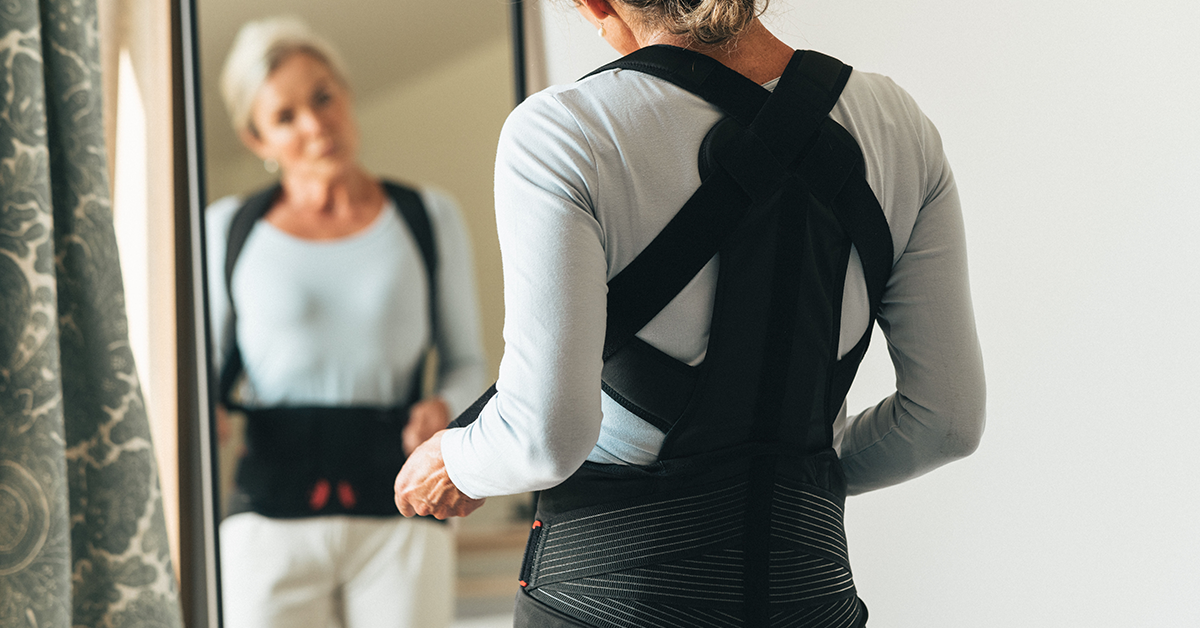
DonJoy Osteostrap is a two-part modular brace comprising a semi-rigid dorsal frame and an adjustable lumbar belt, worn together to provide postural correction and spinal stabilization. Its reverse shoulder straps use hook-and-loop strap tabs to draw the shoulders back and aid correction of kyphotic posture, while the lumbar belt pushes the dorsal stay towards the lumbar spine for stabilization. Increasing shoulder strap tension passively helps to correct thoracic hyper-kyphosis.
Osteostrap’s standout feature is its modular design, which allows 15 combinations of lumbar belt and dorsal frame sizes, accommodating a wide range of spine lengths (C7–S1) and waist circumferences. Carbon yarn woven into the fabric provides monoelasticity — elastic in one direction, supportive in the other — for an anatomical fit. Color-coded visual fitting dots guide patients and clinicians through a straightforward three-step application.
Indications include osteoporosis, stable vertebral fractures, dorsal hyper-kyphosis, osteoarthritis, traumatic fractures, postural dysfunction associated with Parkinson’s disease, and muscular weakness.
DonJoy Spinostrap is an entry-level semi-rigid back brace offering individualized thoracic support in a slim, low-profile design suited to everyday wear under clothing. Its moldable aluminum dorsal frame, adjustable shoulder straps, repositionable strap guide, and customizable lumbar belt allow prescribers and patients to fine-tune fit and corrective tension. Axillary shoulder pads and an optional sternal strap add underarm comfort. Materials are lightweight, breathable, hypoallergenic, and PVC and latex free.
Indications include support of stable spinal fractures, relief of pain and correction of postural dysfunction from dorsal hyper-kyphosis, postural dysfunction associated with Parkinson’s disease, muscular insufficiency or weakness, and spinal osteoarthritis.
Spinostrap is available in three sizes measured from C7 to S1.
A Note on Limitations
It is important to acknowledge that while the benefits of semi-rigid back bracing are well-supported across multiple studies, much of the available evidence is considered to be of low quality. High-quality prospective trials remain scarce, particularly for patients with acute or subacute fractures or severe osteoporosis, for whom bracing may not be appropriate. Clinical judgement remains essential, and bracing should always be prescribed and monitored by a qualified healthcare professional.
Conclusion
For patients with vertebral compression fractures, hyper-kyphosis, or postural dysfunction related to osteoporosis, semi-rigid back bracing represents a clinically supported, non-surgical pathway to pain relief, improved posture, and better quality of life. The evidence consistently favors it over both rigid and soft alternatives, with better compliance and fewer complications. Combined with appropriate medical management, it offers patients a meaningful tool to reclaim function and independence.
For more information on Enovis back braces and other products, visit our website or contact your local representative.
References
- Alexandru, D., & So, W. (2012). Evaluation and management of vertebral compression fractures. The Permanente journal, 16(4), 46–51.
- Beall, D., Lorio, M. P., Yun, B. M., Runa, M. J., Ong, K. L., & Warner, C. B. (2018). Review of Vertebral Augmentation: An Updated Meta-analysis of the Effectiveness. International journal of spine surgery, 12(3), 295–321.
- Rutenberg, T. F., Hershkovitz, A., Jabareen, R., Vitenberg, M., Daglan, E., Iflah, M., Drexler, M., & Shemesh, S. (2023). Can nutritional and inflammatory indices predict 90-day mortality in fragility hip fracture patients?. SICOT-J, 9, 30.
- Madassery S. (2020). Vertebral Compression Fractures: Evaluation and Management. Seminars in interventional radiology, 37(2), 214–219.
- Kato, T., Inose, H., Ichimura, S., Tokuhashi, Y., Nakamura, H., Hoshino, M., Togawa, D., Hirano, T., Haro, H., Ohba, T., Tsuji, T., Sato, K., Sasao, Y., Takahata, M., Otani, K., Momoshima, S., Tateishi, U., Tomita, M., Takemasa, R., Yuasa, M., … Okawa, A. (2019). Comparison of Rigid and Soft-Brace Treatments for Acute Osteoporotic Vertebral Compression Fracture: A Prospective, Randomized, Multicenter Study. Journal of clinical medicine, 8(2), 198.
- Newman, M., Lowe, C.M. and Barker, K., 2016. Spinal orthoses for vertebral osteoporosis and osteoporotic vertebral fracture: a systematic review. Archives of physical medicine and rehabilitation, 97(6), pp.1013-1025.
- Meccariello, L., Muzii, V. F., Falzarano, G., Medici, A., Carta, S., Fortina, M., & Ferrata, P. (2017). Dynamic corset versus three-point brace in the treatment of osteoporotic compression fractures of the thoracic and lumbar spine: a prospective, comparative study. Aging clinical and experimental research, 29(3), 443–449.
- Jacobs, E., Senden, R., McCrum, C., van Rhijn, L. W., Meijer, K., & Willems, P. C. (2019). Effect of a semirigid thoracolumbar orthosis on gait and sagittal alignment in patients with an osteoporotic vertebral compression fracture. Clinical interventions in aging, 14, 671–680.
- Pfeifer, M., Kohlwey, L., Begerow, B., & Minne, H. W. (2011). Effects of two newly developed spinal orthoses on trunk muscle strength, posture, and quality-of-life in women with postmenopausal osteoporosis: a randomized trial. American journal of physical medicine & rehabilitation, 90(10), 805–815.
- Dionyssiotis, Y., Trovas, G., Thoma, S., Lyritis, G., & Papaioannou, N. (2015). Prospective study of spinal orthoses in women. Prosthetics and orthotics international, 39(6), 487–495.
- Kaijser Alin, C., Uzunel, E., Grahn Kronhed, A. C., Alinaghizadeh, H., & Salminen, H. (2019). Effect of treatment on back pain and back extensor strength with a spinal orthosis in older women with osteoporosis: a randomized controlled trial. Archives of osteoporosis, 14(1), 5.